
Overthinking: When Thinking Becomes a Trap
The Overthinking Loop
It’s late at night. The day is over, but your mind is still working. You keep replaying a conversation from work, analyzing every word, every reaction, every gesture. Or you start thinking about the future — what could go wrong, the mistakes you want to avoid, the decisions you still need to make. And even though you know that all this thinking isn’t helping, you just can’t switch it off.
That feeling of being trapped in your own head is something many people know all too well. It’s what psychologists call overthinking — a state where thinking loses its purpose and turns into an endless loop. It’s not a sign of weakness but a protective mechanism that has gone off course. Your brain is trying to gain control where none is possible and to find safety in a world that’s constantly changing.
Overthinking isn’t a matter of being “too intelligent.” It’s a misuse of mental energy — the very thinking that’s meant to help us solve problems ends up paralyzing us instead.
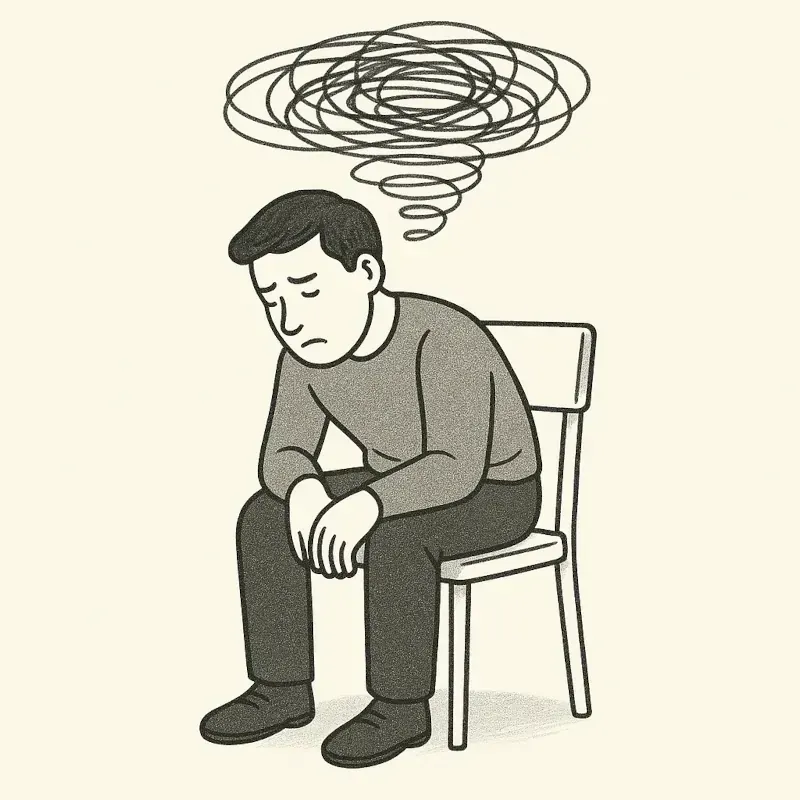
What Overthinking Really Is
Overthinking — often described as getting stuck in your own thoughts — is a mental pattern where your mind keeps circling around the same topic without ever reaching a real conclusion. You could say that thinking loses its direction.
In psychology, this pattern is known as rumination — the repetitive and passive replay of problems, mistakes, or unpleasant experiences. While productive thinking is goal-oriented, rumination just spins in circles. It drains your energy instead of bringing clarity.
At its core, your brain is trying to gain control through analysis. It runs endless “what-if” scenarios to prepare for possible danger — a mechanism that was once essential for survival. But in today’s world, where threats are rarely physical yet constantly psychological, that same system backfires.
Instead of clarity, it creates mental noise.
So overthinking isn’t a character flaw. It’s a well-intentioned but outdated survival strategy — a habit of the mind that means well, but ends up standing in your way.
| Aspect | Overthinking | Reflection |
|---|---|---|
| Goal | Seeking control and safety | Understanding and learning |
| Focus | Mistakes, risks, hypothetical scenarios | Causes, solutions, insights |
| Emotional Impact | Tension, uncertainty | Clarity, acceptance |
| Outcome | Mental loop | Action or calm |
Why Your Brain Won’t Stop Overthinking:
The Psychological Patterns Behind It
From a psychological perspective, overthinking usually stems from two intertwined patterns known in research as rumination and worry. Rumination focuses on the past — those situations you mentally replay over and over, wondering what you could have done differently. Worry, on the other hand, is future-oriented and filled with “what if” scenarios about things that might go wrong. Both patterns have the same effect: they trap you in your head and keep you from finding emotional calm.
This process is reinforced by cognitive distortions — subtle thinking errors that unconsciously twist your perception. You might interpret neutral behavior as rejection, think in extremes, or take responsibility for things beyond your control. These mental filters make the overthinking loop spin even faster, because you don’t see the world as it is, but as your worries color it. The first step toward breaking the cycle is recognizing these hidden mechanisms.
| Cognitive Bias | Example | Effect |
|---|---|---|
| Catastrophizing | “If I make a mistake, everything will fall apart.” | Creates fear and paralyzes action. |
| Mind Reading | “My boss must be disappointed in me.” | Leads to mistrust, self-doubt, and withdrawal. |
| All-or-Nothing Thinking | “Either the presentation is perfect or it’s a total failure.” | Creates pressure and leaves no room for realistic assessment. |
| Personalization | “The meeting went badly — it must be my fault.” | Increases guilt and lowers self-esteem. |
Why We Overthink
There isn’t a single cause of overthinking — but certain psychological patterns make it far more likely.
Often, it starts with perfectionism. The desire to get everything right leads to endless analysis because no decision ever feels “good enough.” Every step is reviewed afterward, every action mentally dissected.
The need for control and the fear of uncertainty also play a major role. When you believe you must understand and predict everything to feel safe, overthinking becomes inevitable. The brain tries to eliminate every possible risk — and in doing so, creates endless new questions.
Another key factor is low self-esteem. When confidence in your own perception is missing, you start seeking safety in thinking. Through constant analysis, you try to gain control where what’s really needed is self-trust.
Past experiences also have a strong, often unconscious influence. If you’ve been criticized, hurt, or embarrassed in the past, your mind develops a kind of inner warning system. The brain stays on “threat detection” mode, overanalyzing situations to prevent old mistakes from repeating.
Ironically, even high intelligence can make you more prone to overthinking. People who think deeply and see multiple possibilities often get lost in hypothetical scenarios.
Overthinking, then, is not a lack of strength, but the mind’s misguided attempt to create safety — just with the wrong tools.
The Emotional Dynamics of Overthinking
Thoughts and emotions are tightly interwoven. The moment an unpleasant thought appears, it triggers a feeling — insecurity, fear, shame, or anger. That feeling, in turn, sparks new thoughts, which reinforce the original concern. This creates a loop where thinking and feeling continually feed each other.
This mechanism becomes especially strong in moments of stress or emotional vulnerability. When you feel hurt or overwhelmed, your mind tries to regain control through thinking. But control is an illusion — and the harder you try to force it, the longer your discomfort lasts.
The paradoxical solution doesn’t lie in thinking, but in feeling. When you allow unpleasant emotions to be present without rushing to analyze them, you take the fuel out of the loop. You learn to let the feeling exist instead of thinking it away. That’s where the first step out of overthinking begins — accepting your inner experience without fighting it.
Understanding Overthinking: What’s Really Happening in Your Brain
Even on a biological level, overthinking can be clearly explained. In your brain, two systems are at play: the amygdala, which triggers alarm and emotional reactions, and the prefrontal cortex, which is responsible for rational thinking and decision-making. When you’re overthinking, the amygdala becomes overactive — it interprets even small uncertainties as potential threats. At the same time, the prefrontal cortex is inhibited, making it hard to stop your thoughts or make clear decisions.
This doesn’t mean something is “wrong” with you. It simply shows that your brain is currently wired for safety. It tries to regain control by analyzing everything — which, ironically, only creates more stress. Once you learn how to regulate this activation, your mental system returns to balance. Mindfulness, breathing techniques, and intentional breaks can all help calm the amygdala and reengage the prefrontal cortex.
The Consequences: When Thinking Becomes Paralysis
Overthinking affects every part of life — quietly, but deeply.
In professional life, it leads to indecision. When you spend too long weighing options, opportunities slip away. Projects stall because every detail is endlessly evaluated. Creativity suffers, as the fear of mistakes kills ideas before they even take shape.
In relationships, overthinking undermines trust. When every word or gesture is analyzed, you start looking for problems that aren’t there. This constant monitoring creates distance, because closeness can only grow where you’re able to let go.
For mental health, overthinking is particularly harmful. It’s closely linked to anxiety, depression, and chronic stress. The body stays in a constant state of alert; the mental loop keeps the nervous system tense and drains your ability to recover.
Overthinking is not harmless reflection — it’s a form of mental exhaustion that burns energy without bringing any real benefit.
The Physical Impact of Overthinking
Overthinking doesn’t just affect your mind — it affects your whole body. Constant rumination keeps your nervous system on high alert. The body releases more stress hormones, muscles tighten, and breathing becomes shallow. Many people notice it first through physical signs: inner restlessness, a racing heart, tense shoulders, or a constant pressure in the chest.
Over time, this state can also disrupt sleep, digestion, and even the immune system. The body sends out warning signals, but when you’re trapped in your head, you often ignore them. Once you start paying attention to these signs, they become a valuable early warning system.
Sometimes, the way out of overthinking is a way back into your body. Movement, breathing exercises, intentional breaks, or a walk in nature can all interrupt the mental loop by directing your attention to where overthinking has no foothold — the present, physical experience.
Ways Out of the Overthinking Loop
The way out of overthinking begins with one simple but crucial step: awareness. As long as you identify with your thoughts, it feels as if you’re at their mercy. But the very moment you recognize, “I’m thinking too much right now,” a small distance appears — and with it, freedom.
That distance from your own thinking is the heart of all change. You can’t switch off your thoughts, but you can learn to believe them less.
It helps to bring your attention back to your body and the present moment. When you notice your mind spinning, pause. Feel the ground beneath your feet. Breathe. Look around. The here and now is the one place where overthinking has no power.
Another effective step is to externalize your thoughts. When you write down what’s on your mind, you step out of your head and give your thoughts form. They lose their blur — and with it, some of their power.
Over time, you can also train your mind to organize its thinking. Schedule specific “worry times.” When thoughts appear outside of that window, note them down and postpone them intentionally. This teaches your brain not to chase every thought the moment it arises.
And finally, practice shifting your perspective. Instead of asking, “Why is this happening to me?” ask, “What can I do right now?” That simple reframe redirects your energy away from the problem — and toward the solution.
The Real Key: Building a New Relationship with Your Thoughts
Overcoming overthinking doesn’t mean thinking less — it means thinking differently. The real shift is metacognitive: developing the ability to step back and think about your own thinking.
When you realize that thoughts are mental events, not facts, something changes. You are not your thoughts — you are the one who notices them.
That insight changes everything. It brings calm where there used to be effort. It creates clarity where confusion once ruled. And it leads to a new kind of inner balance — not because the world has changed, but because you’ve stopped fighting it in your mind.
New Habits and Mental Routines
Overthinking doesn’t disappear through a single insight — it fades through new habits. The mind follows patterns, and patterns only change through repetition. When you start giving your day structure, you help your thinking find order again.
Small rituals often work better than big resolutions. A short journaling session in the morning, a digital shutdown at the end of the workday, or five minutes of mindful breathing in the afternoon can already break the loop. These routines send a signal to your brain: it’s safe to let go.
Over time, this creates a new baseline — less control, more trust. You learn that thoughts can come and go without needing to chase them. Inner tension gives way to clarity, and overthinking slowly turns into calm.
Stopping Overthinking – and Knowing When to Seek Help
Many strategies for dealing with overthinking can make a real difference when practiced consistently. But it’s just as important to understand that self-help has its limits. If you feel mentally drained, find it hard to switch off, or notice your sleep and focus suffering, it’s not a sign of weakness to reach out for support. Overthinking can sometimes be part of a deeper anxiety or obsessive pattern — and in those cases, professional guidance is essential.
Therapeutic approaches such as Cognitive Behavioral Therapy (CBT), Acceptance and Commitment Therapy (ACT), or mindfulness-based interventions can help change these thought patterns for good. The key message is simple: you don’t have to do this alone. Seeking help isn’t giving up — it’s taking responsibility for your own well-being.
Conclusion
Overthinking isn’t a flaw — it’s a learned habit. It’s the mind’s attempt to cope with uncertainty, just in a way that drains you instead of strengthening you. But that also means it’s something you can unlearn.
When you start observing your thoughts instead of following them, when you accept what you can’t control and focus on what you can influence, a sense of lightness returns.
Thinking is a tool — not a prison. Once you begin using that tool consciously, the mental carousel comes to a stop. And in its place, something far more valuable appears: inner calm.
More Articles on Overthinking
📘 Overthinking: When Thinking Becomes a Trap
What happens in your mind when overthinking becomes a habit? The neurobiological and psychological foundations — explained clearly and simply.
→ Read the main article🚪 When Thinking Makes You Withdraw
How overthinking leads to social avoidance — and why trying to protect yourself often results in inner loneliness.
→ Read the article💬 Overthinking in Communication
Why overthinking slows conversations, weakens confidence, and makes clear communication harder.
→ Read the article🧩 Why Some People Tend to Overthink
Personality, emotion, and biology — why some minds react more strongly to uncertainty and slip into overthinking more easily.
→ Read the article📅 How Overthinking Appears in Daily Life
Communication, decisions, overplanning, and control — the everyday patterns that quietly reinforce overthinking.
→ Read the articleYour Free Course

Say What You Mean – Communication Without Overthinking
If you notice that you’re constantly searching for the right words or cutting your sentences short while speaking, this short micro-course will help.
In just a few minutes, you’ll start to recognize the typical overthinking patterns that show up in your language and get a sense of how you can communicate with more clarity, ease, and confidence again.
Your Expert
Oliver Berndorf
Lead Business Analyst, Project Manager, and Instructor
I don’t know overthinking from books — I know it from experience. As a long-time overthinker, I’ve learned firsthand how paralyzing constant rumination can be — and how freeing it feels to clear your mind again. Today, I share that knowledge, combined with more than 20 years of experience in project management and business analysis.
Deepen Your Knowledge
If you want to understand overthinking better and finally break free from it, take a look at my course on Udemy.
There, you’ll learn step by step how to calm your mind, think more clearly, and start acting with more ease again.